Teen Patti (3 Patti) Sequence Chart: Every Hand Ranked, With Odds
Reviewed by Kishan Modi, App Safety Researcher
Last updated: · Added quick answers (Is K-A-2 / 2-3-5 / Q-K-A a sequence?) and a downloadable chart image and PDF.
For adults (18+) only. Real-money online games are prohibited in India under the Promotion and Regulation of Online Gaming Act, 2025, and real-money play carries financial risk and can be habit-forming. Play free where you can, and set a limit before you start. See Responsible Gaming and Disclaimer.
The Teen Patti sequence of hands, strongest first, is: Trail (three cards of the same rank), Pure Sequence (three consecutive cards of one suit), Sequence (three consecutive cards in mixed suits), Color (three cards of one suit), Pair, and High Card. Among the sequences themselves, A-K-Q is the highest under most rules, followed by A-2-3, then K-Q-J and so on down to 4-3-2. Of the 22,100 possible three-card hands, 52 are Trails (0.235%), 48 Pure Sequences (0.217%), 720 Sequences (3.26%), 1,096 Colors (4.96%), 3,744 Pairs (16.94%) and 16,440 High Cards (74.39%).
Teen Patti Sequence Chart: Hand Rankings in Order
Teen Patti uses one 52-card deck with no jokers in the classic game, and every player gets exactly three cards. That gives six kinds of hand. The chart below shows them from strongest to weakest, with a typical example of each. If two players reach a Show, the higher hand on this chart wins the pot.
- 1. Trail (Set)Three cards of the same rank. A-A-A is the best hand in the game.
- 2. Pure SequenceThree consecutive cards, all in one suit.
- 3. Sequence (Run)Three consecutive cards, suits mixed.
- 4. Color (Flush)Three cards of one suit, not consecutive.
- 5. PairTwo cards of the same rank plus one other card.
- 6. High CardAnything else, ranked by its highest card.
| Hand | Ways to make it | Chance | About 1 in |
|---|---|---|---|
| Trail | 52 | 0.235% | 425 hands |
| Pure Sequence | 48 | 0.217% | 460 hands |
| Sequence | 720 | 3.26% | 31 hands |
| Color | 1,096 | 4.96% | 20 hands |
| Pair | 3,744 | 16.94% | 6 hands |
| High Card | 16,440 | 74.39% | 1.3 hands |
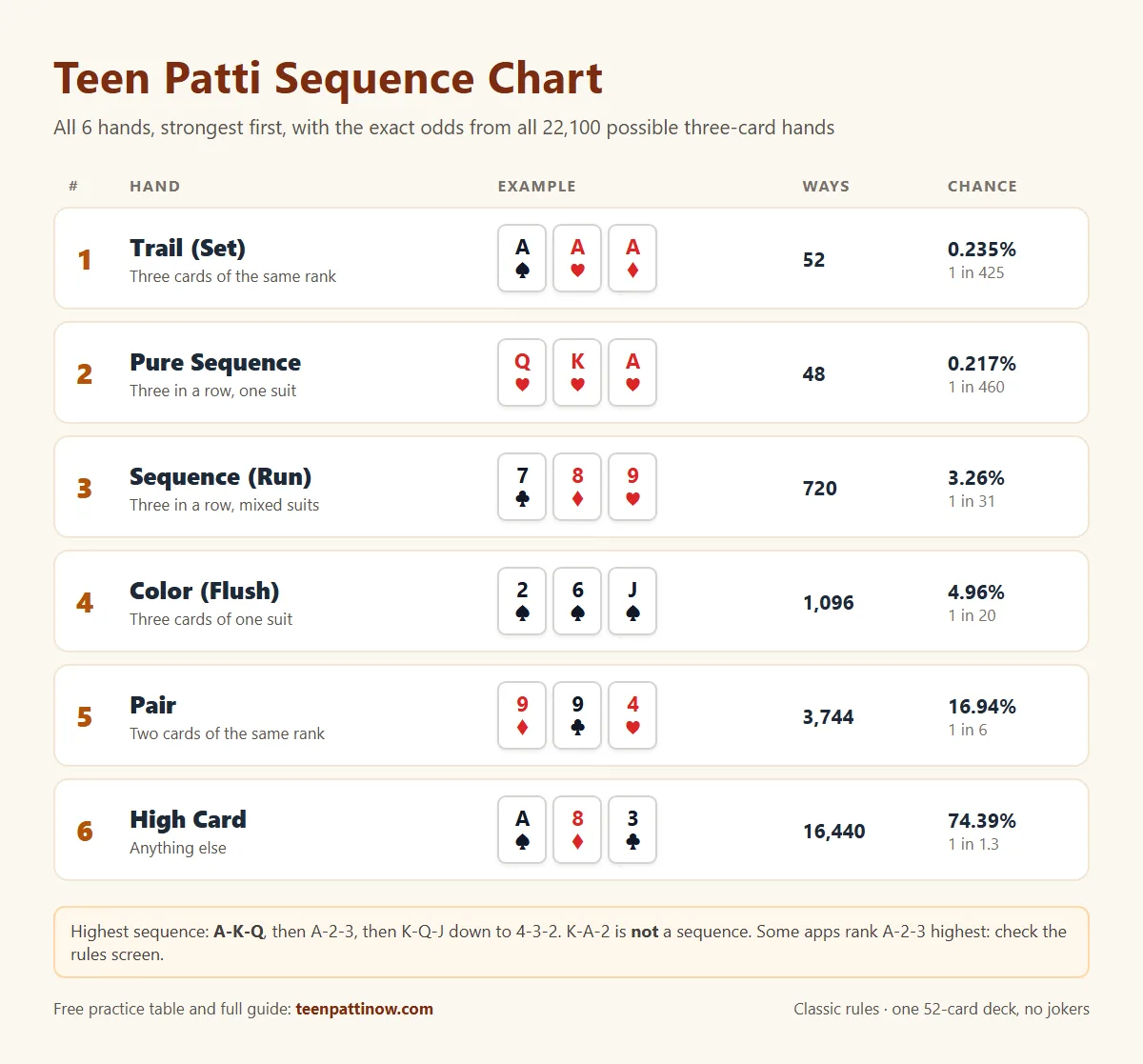
The counts are easy to check by hand. A Trail needs three of the four cards of one rank: 4 ways for each of 13 ranks, so 52. There are 12 possible sequences, and each can be made in a single suit (4 ways, the Pure Sequences, 48 in total) or in mixed suits (60 ways each, 720 in total). A Color is any three cards of one suit (4 × 286 = 1,144) minus the 48 that are also Pure Sequences. A Pair is 13 ranks × 6 ways to pick two suits × 48 possible third cards = 3,744. Everything left over, 16,440 hands, is High Card.
Is It a Sequence? Quick Answers
The questions people ask most about the Teen Patti sequence, answered in one line each. Standard rules: the Ace counts high (Q-K-A) or low (A-2-3) but can't wrap round the corner.
| Cards | Sequence? | Why |
|---|---|---|
| Q-K-A (A-K-Q) | Yes, the highest | Three in a row with the Ace high. A-K-Q beats every other sequence under most rules. |
| A-2-3 | Yes, second highest | Three in a row with the Ace low. A few apps rank it above A-K-Q. |
| K-A-2 | No | The Ace can't sit between the King and the 2, so this is just a High Card hand (or a Color if the suits match). |
| 2-3-4 | Yes, the lowest | The weakest of the 12 sequences. |
| 2-3-5 | No | The cards aren't consecutive, so it isn't a sequence. In mixed suits it's the lowest possible High Card hand. |
| J-Q-K | Yes | Third highest, after A-K-Q and A-2-3. |
| A-K-Q vs A-2-3 | A-K-Q wins | Under most rules. Check the app's rules screen, since some rank A-2-3 first. |
| Same three cards in one suit | Pure Sequence | If all three are one suit, it's a Pure Sequence, which beats any ordinary Sequence. |
Each Teen Patti Hand Explained
Here is each rank with two examples and the mistake beginners most often make with it.
Trail (Set or Trio)
- Highest Trail
- Lowest Trail
Three cards of the same rank. Between two Trails, the higher rank wins, so A-A-A beats K-K-K, and even 2-2-2 beats every hand that isn't a Trail. You'll see one roughly once every 425 hands.
Beginner confusion: some players assume a Pure Sequence must outrank a Trail, as a straight flush beats three of a kind in poker. In Teen Patti the Trail is always higher.
Pure Sequence (Straight Flush)
- Highest Pure Sequence
- A mid-range one
Three consecutive cards in the same suit. It's actually the rarest hand in the game (48 ways against 52 for a Trail), but it ranks second by long-standing convention. Between two Pure Sequences, the higher sequence wins, using the order further down this page.
Beginner confusion: Pure Sequence and Color both have three cards of one suit. The difference is that a Pure Sequence must also be consecutive. 5♣ 6♣ 7♣ is a Pure Sequence; 5♣ 6♣ 9♣ is only a Color.
Sequence (Run or Straight)
- Highest Sequence
- Lowest Sequence
Three consecutive cards in mixed suits. It ranks above Color because, with only three cards, a run is harder to make than three cards of one suit: 720 ways against 1,096. Five-card poker ranks them the other way round, which is the single biggest source of confusion for poker players learning Teen Patti.
Beginner confusion: the Ace can sit at either end (A-K-Q or A-2-3) but can't wrap around the middle. K-A-2 is not a sequence under any common rule.
Color (Flush)
- Highest Color
- Lowest Color
Any three cards of the same suit that aren't consecutive. Between two Colors, compare the highest cards first, then the second-highest, then the third. A-K-J of one suit beats A-K-10 of another, and suit itself doesn't break the tie.
Pair
- Highest Pair
- Lowest Pair
Two cards of the same rank plus a third card. The higher pair wins; if both players have the same pair, the higher third card (the kicker) decides. Any pair beats about 74% of all possible hands, which is why a pair is a strong holding against one or two opponents.
High Card
- Best High Card
- Worst hand in the game
Any hand that isn't one of the above. Compare the highest card, then the next, then the last. Three-quarters of all hands are High Card, and a King-high hand is roughly average. The worst possible hand in the game is 5-3-2 in mixed suits: 4-3-2 would be a sequence, so 5-3-2 is the lowest set of three unconnected cards and loses to every other hand.
Sequence vs Pure Sequence vs Color
These three are the hands beginners mix up most, because they all involve either consecutive cards or matching suits. The table shows what each needs and how they rank against each other.
| Pure Sequence | Sequence | Color | |
|---|---|---|---|
| Cards must be consecutive? | Yes | Yes | No |
| Cards must share a suit? | Yes | No | Yes |
| Example | 4♥ 5♥ 6♥ | 4♥ 5♣ 6♦ | 4♥ 9♥ Q♥ |
| Rank | 2nd (below Trail) | 3rd | 4th |
| Ways to make it | 48 | 720 | 1,096 |
| Beats a Color? | Yes | Yes | Only a lower Color |
Which Sequence Wins? A-K-Q, A-2-3 and the Full Order
When two players both hold a Sequence (or both hold a Pure Sequence), the higher sequence wins. Most apps and house rules use the order below, with A-K-Q at the top and A-2-3 second.
| Order | Sequence |
|---|---|
| 1 (highest) | A-K-Q |
| 2 | A-2-3 |
| 3 | K-Q-J |
| 4 | Q-J-10 |
| 5 | J-10-9 |
| 6 | 10-9-8 |
| 7 | 9-8-7 |
| 8 | 8-7-6 |
| 9 | 7-6-5 |
| 10 | 6-5-4 |
| 11 | 5-4-3 |
| 12 (lowest) | 4-3-2 |
House-rule variation: some home games and a few apps rank A-2-3 as the highest sequence, above A-K-Q. Neither is "wrong"; it's a local rule. Agree on it before a home game starts, and check the rules screen before playing on an app, because it decides close hands.
How Ties Are Broken
- Trail: the higher rank wins.
- Pure Sequence and Sequence: the higher sequence wins, using the order above.
- Color and High Card: compare the highest card, then the second, then the third.
- Pair: the higher pair wins; if the pairs match, the higher third card wins.
- Identical hands (for example two A-K-J Colors in different suits): most apps split the pot. Some home games use suit order instead, so agree on it first.
How Strong Is Your Hand?
Because three-quarters of all hands are High Card, even modest hands beat most of the range. Knowing roughly where your hand sits is the basis of every good betting decision.
| Your hand | Beats this share of all hands |
|---|---|
| 7-5-2 mixed suits | 2.7% |
| K-8-6 High Card | 47.5% |
| A-K-J High Card | 74.1% |
| Pair of 2s | 74.4% |
| Pair of Aces | 91.2% |
| Lowest Color (5-3-2) | 91.3% |
| Lowest Sequence (4-3-2) | 96.3% |
How much a hand is worth also depends on how many players are still in. Our guide on how to win at Teen Patti shows how quickly a hand's chances fall as the table fills up.
Practise the Sequence Free
The quickest way to memorise the Teen Patti sequence is to see it in real hands. Our free Teen Patti practice table deals real hands in your browser, names each one when you look at your cards, and tells you what share of all hands it beats. No sign-up, no download and virtual chips only. For the rules around the chart, see the Teen Patti game guide, and for how variants change the order, see Teen Patti variations.
How to Remember the Teen Patti Sequence
Beginners mix up the middle of the order more than the top or bottom. Three simple ideas fix most of it.
- Three of the same beats everything. A Trail tops the chart, even 2-2-2.
- Runs beat suits. Anything consecutive (Pure Sequence, Sequence) beats a Color, and a Pure Sequence is both, so it sits just under the Trail.
- Then pairs, then nothing. A Pair beats High Card, and High Card is decided card by card.
A quick check at the table: if two hands are both consecutive, compare them on the sequence list; if neither is consecutive but both share a suit, compare top cards; and if you're unsure whether something is a sequence, remember the Ace can only sit at either end, never in the middle.
How Variants Change the Sequence
| Variant | Effect on the hand order |
|---|---|
| Classic | The order on this page |
| Muflis (Lowball) | Reversed: the weakest classic hand wins, so 5-3-2 mixed suits becomes the best hand |
| AK47 | Same order, but Aces, Kings, 4s and 7s are wild, so Trails and Sequences become common |
| Joker | Same order; one rank is wild each hand, so a natural pair is much weaker than usual |
| 999 | The order doesn't apply: the hand closest to 999 wins |
Each variant is explained in full in our Teen Patti variations guide.
Settling Common Sequence Disputes at Home
- "Is A-2-3 higher than A-K-Q?" Decide before the first hand. Most apps put A-K-Q on top; plenty of families don't.
- "K-A-2 is a sequence!" It isn't under any common rule; the Ace doesn't wrap around.
- "My Color has the better suit." Suit doesn't usually break ties in Teen Patti; identical ranks split the pot unless you've agreed suit order.
- "My Pure Sequence beats your Trail." Not in Teen Patti. It does in Three Card Poker, which is a different game.
Teen Patti Sequence: FAQ
What is the correct sequence of hands in Teen Patti?
From strongest to weakest: Trail, Pure Sequence, Sequence, Color, Pair, High Card. A Trail (three of a kind) is the best hand, and High Card is the weakest.
What is the highest sequence in Teen Patti?
A-K-Q is the highest sequence under most rules, followed by A-2-3, then K-Q-J. A few apps and home games rank A-2-3 highest, so check the rules screen.
Is A-2-3 a sequence in Teen Patti?
Yes. A-2-3 is a valid sequence and usually the second-highest. K-A-2 is not a sequence, because the Ace can't wrap around between King and 2.
Is K-A-2 a sequence in Teen Patti?
No. Under standard rules the Ace can be high (Q-K-A) or low (A-2-3) but can't wrap round, so K-A-2 is a High Card hand, or a Color if all three cards share a suit.
Is 2-3-5 the biggest sequence in Teen Patti?
No. 2-3-5 isn't a sequence at all, because the cards aren't consecutive. In mixed suits it's actually the lowest possible High Card hand. The biggest sequence is A-K-Q.
Does Color beat Sequence in Teen Patti?
No. Sequence beats Color in Teen Patti, because with three cards a sequence is harder to make (720 ways against 1,096). This is the reverse of five-card poker.
Which is rarer, a Trail or a Pure Sequence?
A Pure Sequence, narrowly: 48 possible hands against 52 for a Trail. The Trail still ranks higher by convention.
What happens if two players have the same hand?
Most apps split the pot when two hands are identical in rank. Some home games break the tie by suit order instead, so agree on the rule before you start.